
We are passionate about physics and committed to helping every student reach their full potential. Our track record speaks for itself, with consistently outstanding results.
Our department is staffed by four highly specialised teachers, with expertise spanning particle physics, capacitor technology, fusion physics and mechanical engineering. This breadth of experience allows us to bring a wealth of specialist knowledge and real-world perspectives into the classroom.
We follow the AQA A-level specification, with Astronomy as our optional unit. The course builds on the core knowledge developed at GCSE, including mechanics, materials, waves and electricity, while introducing students to exciting new areas such as quantum and particle physics. Students have the opportunity to explore some of the most fascinating and cutting-edge areas of modern science.
A-level teaching is shared between two teachers, with each teacher delivering four lessons per week. This provides students with the benefit of different teaching styles and areas of expertise throughout the course.
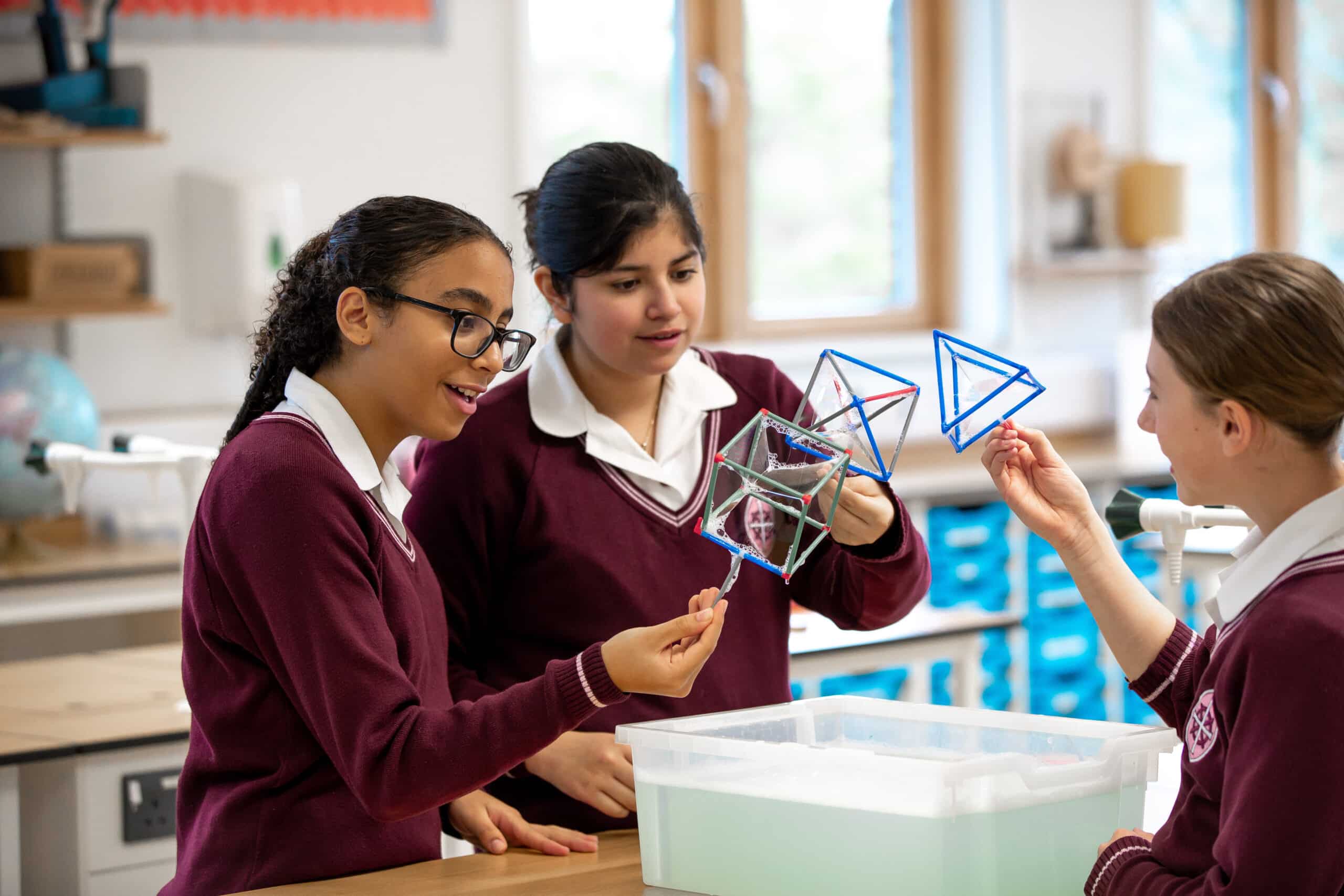
We believe that hands-on experience is essential to developing a deep understanding of physics. Our well-resourced laboratories enable us to place practical work at the heart of our teaching, with students completing extensive practical investigations well beyond the requirements of the specification. Through this work, students develop not only their practical skills but also a deeper understanding of scientific enquiry, including experimental design, data analysis and evaluation.
A-level Physics opens the door to a wide range of university courses and careers. Many of our students continue to study physics or related subjects such as theoretical physics, astrophysics, geophysics and engineering. Physics also provides an excellent foundation for subjects including mathematics, chemistry, biology, architecture and sports science, as well as careers in areas such as medicine, computing, design, economics and law. The analytical, problem-solving and critical-thinking skills developed through studying physics are highly valued across a wide range of fields.
Topics studied
Year 1
- Measurement and their errors
- Mechanics
- Materials
- Electricity
- Waves
- Optics
- Particle physics
- Quantum physics
Year 2
- Further mechanics (circular motion and simple harmonic motion)
- Magnetic fields
- Electromagnetism
- Thermal physics
- Electric and gravitational physics
- Nuclear physics
- Astrophysics
40.0%
A* in A level Physics in 2026
70.0%
A*–A in A level Physics in 2026
100.0%
A*–C in A level Physics in 2026
Academic enrichment
We believe in fostering a love of physics through hands-on experiences and exciting opportunities. You can compete in both the theory and practical project categories of the British Physics Olympiad, the latter providing an opportunity to conduct your own independent research projects. Students may also elect to compete in the British Astronomical Olympiad. Various other competitions are promoted each year, including the prestigious Warwick University Materials Science Competition (XMaS Scientist) – which students from St Helen’s have won for the past four years.
We encourage student leadership by providing opportunities to lead activities for the Year 7 Science Club, provide support for Lower School CREST club, or support the Royal Society Young People’s Book Prize judging panel.
For those who aspire to study at Oxbridge, we offer bespoke sessions to help prepare them for the rigorous admissions process. Additionally, our weekly enrichment ‘Problem Solving Club’ and Lent Term’s ‘Beyond Physics’ club provide even more opportunities for you to delve deeper into the wonder of physics – be that complex theories or how physics is portrayed in popular culture.
Astronomy Club is offered to students from Year 9 upwards and delves into the complex physics of the cosmos. On darker evenings we are able to use our departmental telescopes and digital astro camera to undertake stargazing events.
We also take learning outside the classroom through attendance at public lectures and trips to places like the Rutherford Appleton Laboratory (RAL) and JET Culham.